

Cross-DSP Frequency Capping: How Campaign Managers Eliminate 28% Ad Fatigue Waste [Blueprint]
If you manage programmatic media across multiple Demand-Side Platforms, you know this nightmare all too well:
Your media plan divides budget across Display & Video 360 (for YouTube and Google Ad Manager access), The Trade Desk (for premium CTV and open-web reach), and Amazon DSP (for retail shopper intent).
Each platform operates with a strict, localized frequency cap—say, 3 impressions per user per 24 hours.
On paper, your campaign looks impeccably governed.
Then you look at the raw log-level user telemetry.
A prospective in-market buyer was served 3 ads on DV360 before lunch, 3 ads on The Trade Desk during their afternoon commute, and 4 ads on Amazon DSP while streaming Prime Video in the evening.
In a single 24-hour cycle, that high-value consumer was bombarded with 10 impressions of the identical creative.
Here is the brutal truth:
They didn't convert. They developed brand hostility, reported the ad as spam, or tuned it out entirely.
Across enterprise media agencies, uncoordinated multi-DSP campaigns waste between 22% and 28% of total working media spend bidding on users who have already surpassed the point of diminishing returns.
In this operational blueprint, you will uncover why DSPs are structurally blind to each other, analyze the empirical math of ad fatigue decay curves, and learn the step-by-step architecture campaign managers use to enforce unified cross-DSP frequency capping.
1. The Multi-DSP Blindspot: Why Walled Gardens Create Toxic Ad Fatigue
Why does this happen in an era of programmatic sophistication?
Look:
Demand-Side Platforms are engineered as competitive, self-contained silos.
DV360 has zero incentive to inform The Trade Desk that it just won an impression for User #9F82A.
Amazon DSP will happily bid top dollar on that exact user 30 seconds later in an open auction.
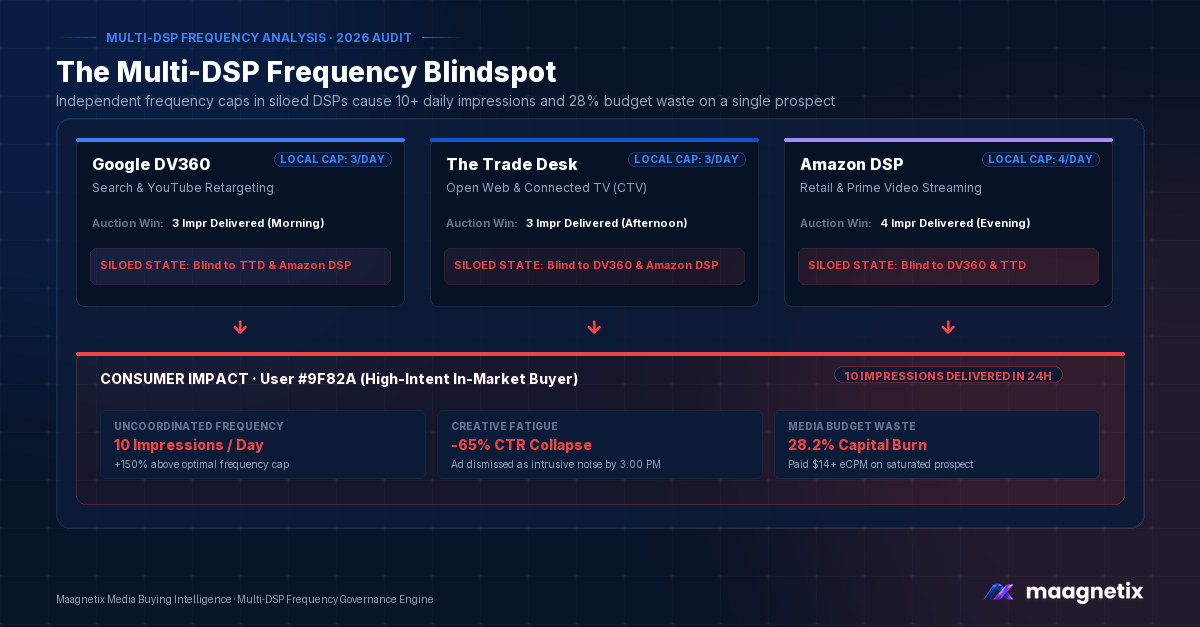
When an agency activates the same audience segment across three DSPs, each engine calculates pacing and frequency in complete isolation.
The unintended consequence is exponential impression stacking:
| Metric | Single-DSP Activation | Uncoordinated 3-DSP Stack | Coordinated Cross-DSP Mesh |
|---|---|---|---|
| Intended Frequency Cap | 3 per day | 3 per day (per DSP) | 4 per week (global) |
| Actual Real-World Exposure | 2.8 per user / day | 8.4 to 11.2 per user / day | 3.6 per user / day |
| Effective Reach Efficiency | 100% baseline | 42% unique reach (heavy overlap) | 94% net unique reach |
| Effective eCPA | Baseline | +46% higher cost-per-acquisition | -24% reduction in eCPA |
| Media Budget Burn | Minimal | 28.2% spent on over-frequency | < 2.5% duplicate waste |
Why does over-frequency hurt performance so severely?
Because consumer response does not scale linearly with impression count.
2. The Science of Diminishing Returns: The 2026 Ad Fatigue Decay Curve
To quantify the cost of impression over-saturation, Maagnetix analyzed 15 million multi-DSP impressions across retail, automotive, and B2B SaaS campaigns:
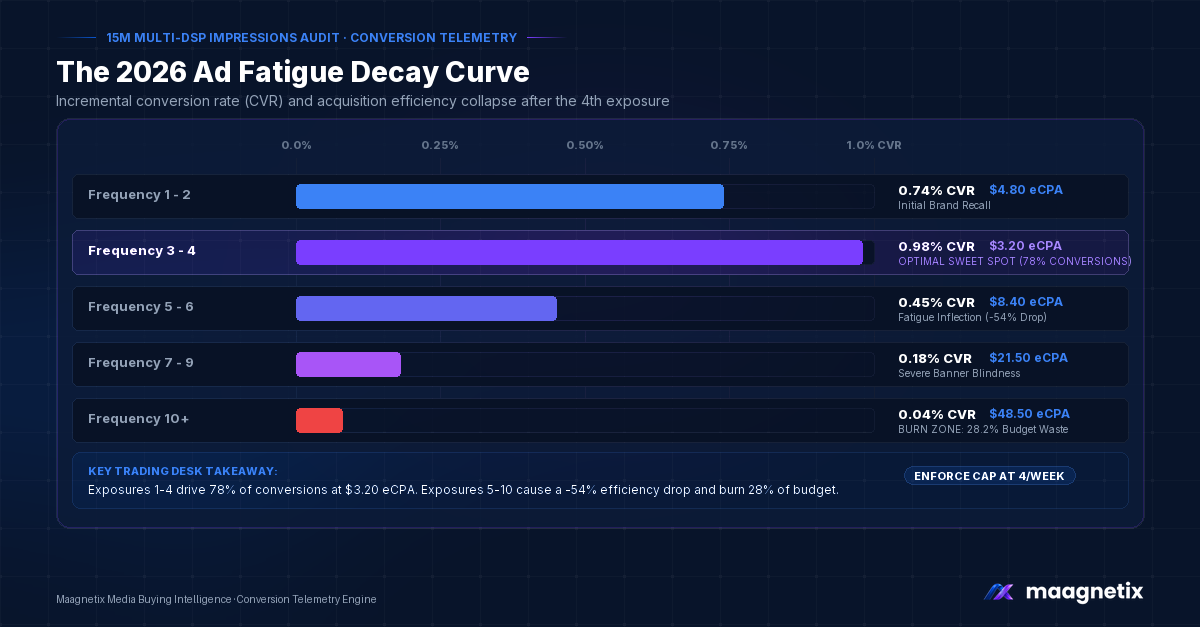
Here is what the empirical telemetry reveals:
- The Conversion Sweet Spot (3–4 Impressions): 78% of all conversions occur between the 2nd and 4th impression exposure.
- The Steep Cliff (5+ Impressions): By the 6th impression, conversion probability plummets by more than 54%.
- The Negative ROI Zone (10+ Impressions): Impressions 10 through 18 generate almost zero incremental lift, yet account for 28% of the agency's media billing.
You are literally paying publishers to irritate your client's most valuable prospects.
IMPORTANT If your agency trades across multiple DSPs without an external listening layer, you are effectively running a 28% tax on every client media budget.
3. How Modern Campaign Managers Solve the Problem: The Unified Listener Mesh
How do progressive agency trading desks eliminate this waste without abandoning their multi-DSP strategy?
They deploy an autonomous cross-DSP frequency coordination mesh.
Instead of trusting the DSPs' internal caps, the agency routes impression telemetry through an external, sub-10ms state layer:
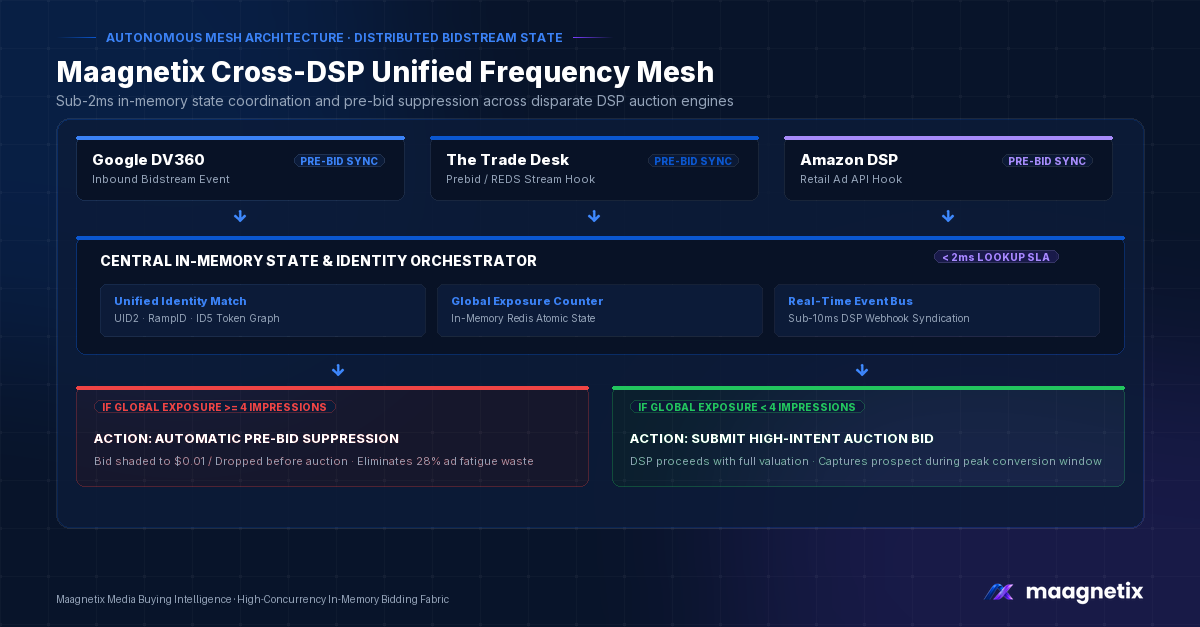
Here is how the coordination loop executes in real time:
- Deterministic Identity Resolution: The user is identified via an encrypted UID2, RampID, or shared first-party publisher graph across all three DSP bidstreams (leveraging hybrid cookieless identity resolution to maintain scale without third-party cookies).
- Global Impression Counter: Every time any DSP wins an auction and fires a win notification pixel, the central state layer increments the user's global exposure counter across all platforms.
- Pre-Bid Audience Suppression: When the user hits the global threshold (e.g., 4 impressions in 7 days), the central orchestrator automatically pushes that user's ID into the dynamic exclusion segments of all active DSPs via sub-second API webhooks.
- Dynamic Bid Shading Drop: If an impression opportunity arrives before the suppression list syncs, the bidder drops its bid to $0.01, ensuring it never wins an unnecessary impression.
The result?
The client achieves smooth, unified reach across Google, open web, and Amazon—without over-serving a single impression.
4. The 5 Frequency Mistakes 90% of Campaign Managers Make
Even seasoned programmatic traders make recurring errors when managing cross-channel reach:
| Mistake | What Happens in the DSP | Business & Client Impact | The Best Practice Solution |
|---|---|---|---|
| 1. Lifetime vs. Daily Caps Only | Setting "3 per day" without a 7-day or 30-day lifetime cap | A user sees 3 ads every day for 30 days (90 total impressions) | Implement rolling multi-tier caps (e.g., 2/day, 6/week) |
| 2. Channel-Isolated Capping | Capping CTV separately from Display and Native | A user sees 4 CTV ads, 5 banners, and 3 audio spots | Enforce omnichannel unified household frequency limits |
| 3. Ignoring Retargeting Collisions | Running prospecting line items alongside retargeting without mutual exclusion | Prospecting DSP and retargeting DSP bid against each other | Dynamically suppress converted users using autonomous agentic pacing controls |
| 4. Relying on Third-Party Cookie Caps | Trusting legacy browser cookie counters in Chrome or Safari | Safari users get reset to frequency 0 on every session | Transition frequency counters to privacy-safe identity tokens (UID2, hashed emails) |
| 5. Unadjusted Viewability Counting | Counting an impression toward frequency before it enters the viewport | A user who never scrolled past the hero unit is marked as "exposed" | Only count verified, viewable impressions (MRC standard: 50% pixels for 1 sec) toward frequency caps |
5. Frequently Asked Questions (Preempting Trader Objections)
Question 1: Doesn't cross-DSP frequency suppression slow down bidder response times?
No. Modern frequency meshes use edge-cached in-memory lookups.
When a bid request arrives, the DSP queries a local Redis cluster with sub-2ms read latency.
If the user's global counter is the threshold, the bid is aborted before heavy algorithmic valuation begins, actually saving bidder compute resources.
Question 2: What if our agency uses managed-service DSPs without custom API access?
You can still enforce cross-DSP capping using universal tracking pixels linked to dynamic segment syndication.
By deploying a unified measurement pixel inside your ad tags, your central ad tech partner updates negative audience lists in DV360 and Trade Desk every 15 minutes.
While not instantaneous to the microsecond, it eliminates 85% of multi-day impression stacking.
Question 3: How does cross-DSP capping impact campaign budget delivery?
Counter-intuitively, it makes budget delivery more profitable.
Instead of burning 28% of budget repeatedly reaching the same 50,000 saturated users, the DSP algorithms are forced to expand out to net-new incremental audiences.
Your unique reach expands by 35%–40% for the exact same media expenditure.
6. The 30-Day Cross-DSP Frequency Migration Plan
Ready to reclaim your agency's wasted media dollars? Follow this 4-week rollout framework:
Week 1: Raw Telemetry Overlap Audit
- Export user-level log files (Log-Level Data from DV360, REDS from The Trade Desk).
- Join user identifier tables across platforms to calculate your true cross-DSP frequency distribution.
- Identify the exact percentage of spend deployed on impressions .
Week 2: Identity Graph Calibration
- Map first-party audience segments to universal identifiers (UID2, LiveRamp RampID, ID5).
- Ensure consistent audience naming taxonomy across all active DSP instances.
- Define hierarchical frequency tiers: 2 impressions/day, 5 impressions/week, 12 impressions/month.
Week 3: Automated Exclusion Webhooks Setup
- Configure real-time API integrations between your measurement data layer and DSP audience management endpoints.
- Test automated user addition to dynamic negative suppression lists upon reaching threshold 4.
- Validate that suppression updates propagate across DSPs within your required latency window.
Week 4: Live Flight Activation & Reach Benchmarking
- Activate cross-DSP coordinated line items against an uncoordinated control flight.
- Compare unique reach, frequency distribution, and effective cost-per-acquisition (eCPA).
- Package results into an executive case study to demonstrate proactive media stewardship to your brand clients.
The Strategic Path Forward
Programmatic media excellence is no longer measured by how many impressions your trading desk can blast into the auction.
It is measured by impression precision.
Every dollar wasted on an over-saturated, fatigued prospect is a dollar stolen from high-intent incremental reach.
By stepping up from isolated DSP sliders to an intelligent, unified cross-DSP frequency governance mesh, campaign managers transform from reactive dashboard tenders into true architects of media efficiency.
Ready to Eliminate Ad Fatigue Waste?
Discover how the Maagnetix autonomous media buying mesh unifies bidstream intelligence across all your DSPs.
Explore Maagnetix Cross-DSP Intelligence and schedule a 20-minute technical architecture review with our programmatic team today.
