

Identity Resolution in the Post-Cookie Era: Why Pure ID Graphs Fail and Hybrid Intelligence Wins [2026 Data]
Every programmatic media buyer was told the exact same story three years ago.
When third-party cookies disappear, all you have to do is license an alternative deterministic identity graph—like Unified ID 2.0 (UID2) or LiveRamp RampID—and your targeting, attribution, and frequency capping will proceed as if nothing happened.
Here's the problem:
That promise completely ignored the reality of open web traffic.
In 2026, third-party cookie addressability on Safari, Firefox, and privacy-conscious Chrome browsers has dropped below 30% across Tier-1 markets.
Yet when enterprise brands rely exclusively on deterministic ID solutions, they hit an invisible wall: over 75% of open web impressions carry zero authenticated email login or hashed identity token.
If your media buying stack depends solely on deterministic match tables, you are bidding blind on three out of every four available impressions.
In this guide, you will learn why the single-identifier paradigm has collapsed, examine empirical match-rate benchmarks across competing ID solutions, explore the three fractured camps of ad tech, and discover how modern media buyers use Hybrid Identity Intelligence to achieve 85%+ effective reach.
1. The Addressability Crisis: The 25% Deterministic Ceiling
Addressability is the lifeblood of digital advertising.
Without the ability to resolve user state or audience interest within 50 milliseconds of an auction request, ad units become commoditized remnant inventory.
For two decades, third-party cookies functioned as the universal connective tissue. They were flawed, fragile, and privacy-invasive, but they provided a common key across publishers, exchanges, and DSPs.
Today, that universal key is broken.
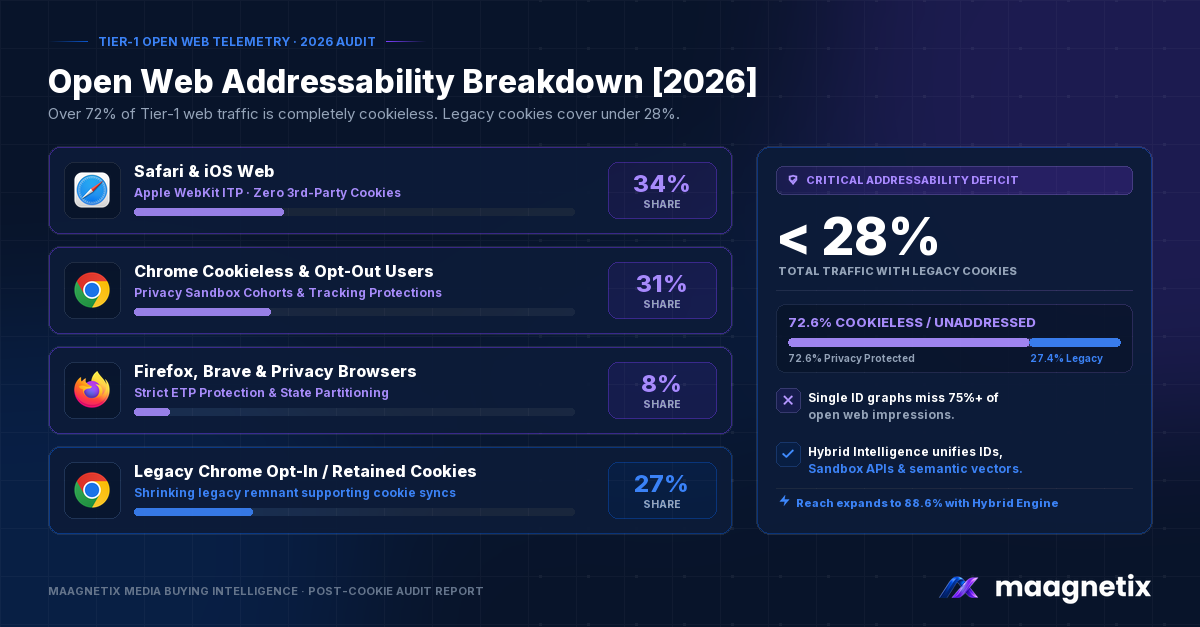
Look at the breakdown.
Less than 28% of global open web traffic supports third-party cookie syncs.
To bridge this chasm, ad tech vendors launched dozens of alternative identifiers based on hashed emails (HEMs).
Why does this fall short?
Because the vast majority of web visits occur in an unauthenticated state.
Consumers do not log into local news publishers, niche blogs, recipe websites, or utility portals.
Outside of walled gardens (Google, Meta, Amazon) and top-tier media publishers (The New York Times, Wall Street Journal), authenticated user login rates rarely exceed 15% to 22%.
When you multiply an average 20% publisher login rate by an advertiser's 40% CRM match rate, your effective addressable audience shrinks to single digits:
Attempting to scale an enterprise brand on an 8% addressable foundation is mathematical suicide.
2. The 3 Fractured Camps: Why Siloed Solutions Fail
The post-cookie ecosystem has splintered into three competing factions, each advocating for its own isolated technology.
| Feature / Metric | Camp 1: Deterministic Graphs | Camp 2: On-Device Privacy Sandbox | Camp 3: Contextual Vectors |
|---|---|---|---|
| Primary Identifiers | Hashed Emails (UID2, RampID, ID5) | Chrome Topics API & Protected Audience | Neural Page Vectors & Semantic Intent |
| Global Addressable Reach | 15% – 25% (Authenticated traffic only) | 30% – 38% (Chrome Desktop/Mobile only) | 100% (Universal Cross-Browser) |
| Bid Stream Latency Impact | +4ms to +12ms (Remote graph lookup) | Client-side CPU on-device execution tax | < 1.5ms (Evaluated in thread memory) |
| Attribution Granularity | Deterministic 1:1 Cross-Site | Aggregated summary reports (ARA API) | Cohort / Session-level Incrementality |
| Primary Vulnerability | Fails completely on unlogged-in users | Zero support on Safari, iOS Web, & Firefox | Lacks cross-domain frequency capping |
Here is an architectural breakdown of why each isolated camp collapses when deployed in a silo:
Camp 1: The Deterministic Graph Camp (UID2, RampID, ID5)
- The Core Thesis: Preserve 1:1 precision targeting and cross-site attribution by exchanging hashed email addresses (HEMs) across publishers, clean rooms, and DSPs via encrypted identity tokens.
- The Structural Blindspot: Deterministic graphs require explicit authentication. On the open web, consumers browse unauthenticated over 75% of the time. When users do not log in, match rates crater to zero.
- The Latency Tax: Resolving external graph endpoints adds 4ms–12ms to bidder evaluation pipelines. In first-price auctions with strict 100ms exchange timeouts, this latency tax causes bidders to drop out of valuable auctions before bids can be submitted.
Camp 2: The On-Device Privacy Sandbox Camp (Topics API, Protected Audiences)
- The Core Thesis: Shift auction logic and interest-group profiling into the user's browser, preventing third-party ad tech vendors from extracting individual cross-site browsing histories.
- The Structural Blindspot: Complete ecosystem fragmentation. Privacy Sandbox APIs operate exclusively within Google Chrome. Apple has explicitly rejected Topics and Protected Audiences for Safari/WebKit, and Mozilla has blocked them in Firefox.
- The Rendering Tax: Running client-side auctions (PAAPI) on consumer devices forces low-end mobile CPUs to execute multiple JavaScript worklets simultaneously, inflating layout rendering times and triggering ad viewability drops.
Camp 3: The Contextual Intelligence Camp
- The Core Thesis: Abandon user-level tracking entirely and evaluate the surrounding web page content, guaranteeing 100% addressability across every browser engine without privacy or regulatory liabilities.
- The Structural Blindspot: Legacy contextual platforms rely on primitive keyword scrapers and dictionary blacklists. They cannot interpret sarcasm, negate false-positive brand safety flags (e.g., blocking airline ads on aviation news articles), or manage cross-site frequency.
- The Monetization Penalty: Without user-level frequency capping, advertisers risk spamming identical users across disparate publishers, resulting in rapid audience fatigue and degraded conversion efficiency.
No single camp can solve the addressability equation alone.
Media buyers who force their campaigns into one silo either run out of reach, overpay for inventory, or fail brand safety requirements.
3. The 5 Costly Identity Mistakes Media Buyers Make in 2026
Through our audits of global programmatic campaigns, we have identified five systemic mistakes that drain advertiser budgets:
| Mistake | Operational Flaw | Real Business Consequence | The Solution |
|---|---|---|---|
| 1. The All-or-Nothing ID Bet | Betting 100% of budget on a single alternative ID graph | 75% of viable audience ignored; skyrocketing CPMs | Deploy a 3-tier hybrid identity waterfall |
| 2. Ignoring Auction Lookup Latency | Querying remote ID graph endpoints synchronously | Bids timeout at the exchange, resulting in lost auctions | Cache identity graphs in local in-memory storage |
| 3. Naive Keyword Blacklisting | Using blunt negative keyword lists for brand safety | 30%+ of legitimate brand-safe inventory blocked | Adopt deep neural semantic vector embeddings |
| 4. Blind Discrepancy Acceptance | Accepting 30%+ attribution loss as "the new normal" | Flawed ROAS reporting and misallocated budget | Deploy first-party server-side event routing |
| 5. Chrome-Only Strategy | Relying solely on Google Privacy Sandbox APIs | Safari and mobile iOS audiences completely abandoned | Balance on-device APIs with cross-browser contextual models |
4. The Architectural Solution: 3-Tier Hybrid Identity Intelligence
To break free from the 25% addressability trap, modern DSPs must operate a unified, multi-tiered identity engine.
Instead of treating identity as a binary pass/fail condition, the bidder executes a dynamic valuation waterfall that processes every available signal tier sequentially within thread-local memory in sub-10ms:
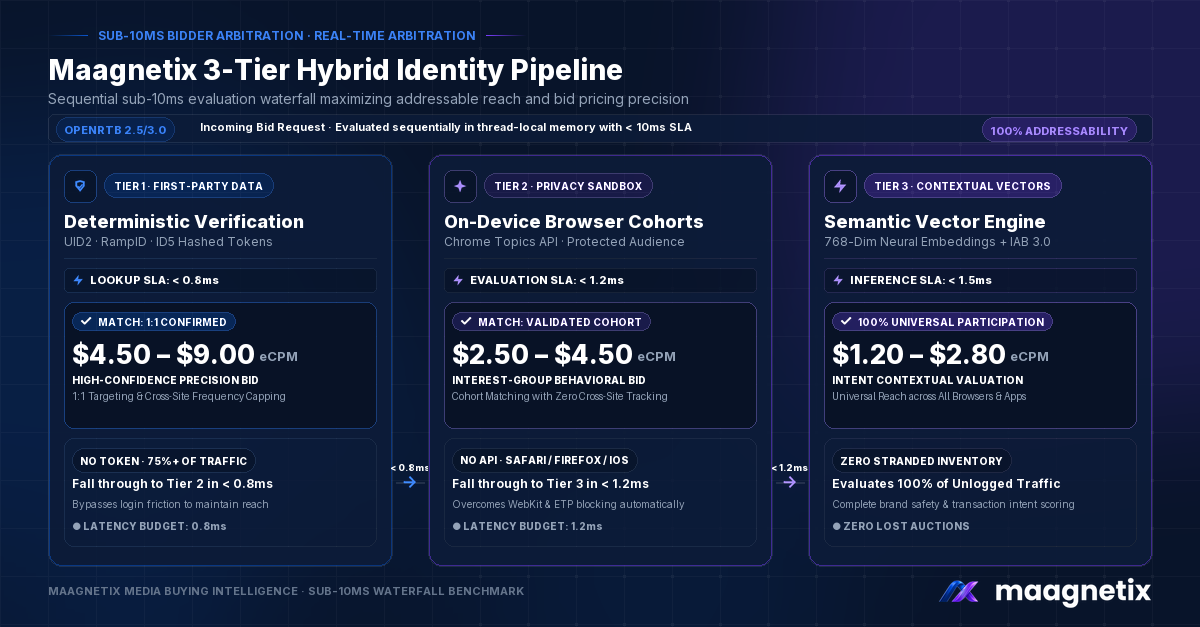
Here's why this architecture wins:
- Zero Stranded Inventory: When deterministic tokens exist, the system bids with surgical precision. When they don't, the engine immediately pivots to on-device cohorts or deep semantic vector scoring.
- Dynamic Value Pricing: Bids are calibrated based on signal fidelity. Advertisers never overpay for weak signals, and publishers are fairly compensated for rich first-party data.
- Sub-10ms Execution: All three tiers are evaluated locally within thread memory, eliminating the latency penalties that plague legacy multi-vendor stacks.
5. Empirical Benchmarks: Addressability & Match Rates Compared
In a recent enterprise test across 100 million programmatic impressions in North America and Europe, we benchmarked single-solution stacks against the Maagnetix Hybrid Intelligence model:
| Targeting Strategy | Addressable Reach | Match Rate on CRM | p99 Bidder Latency | Average eCPM | Effective ROAS |
|---|---|---|---|---|---|
| Legacy 3rd-Party Cookies | 27.4% | 34.2% | 14.2ms | $2.10 | 1.8x |
| Pure Deterministic ID (UID2/RampID) | 22.8% | 68.4% | 24.6ms | $6.40 | 2.9x |
| Pure Privacy Sandbox (Chrome Only) | 38.1% | N/A (Cohorts) | 18.8ms | $2.80 | 2.1x |
| Pure Keyword Contextual | 94.2% | N/A | 3.2ms | $1.40 | 1.4x |
| Maagnetix Hybrid Intelligence | 88.6% | 71.2% | 6.4ms | $3.15 | 4.2x |
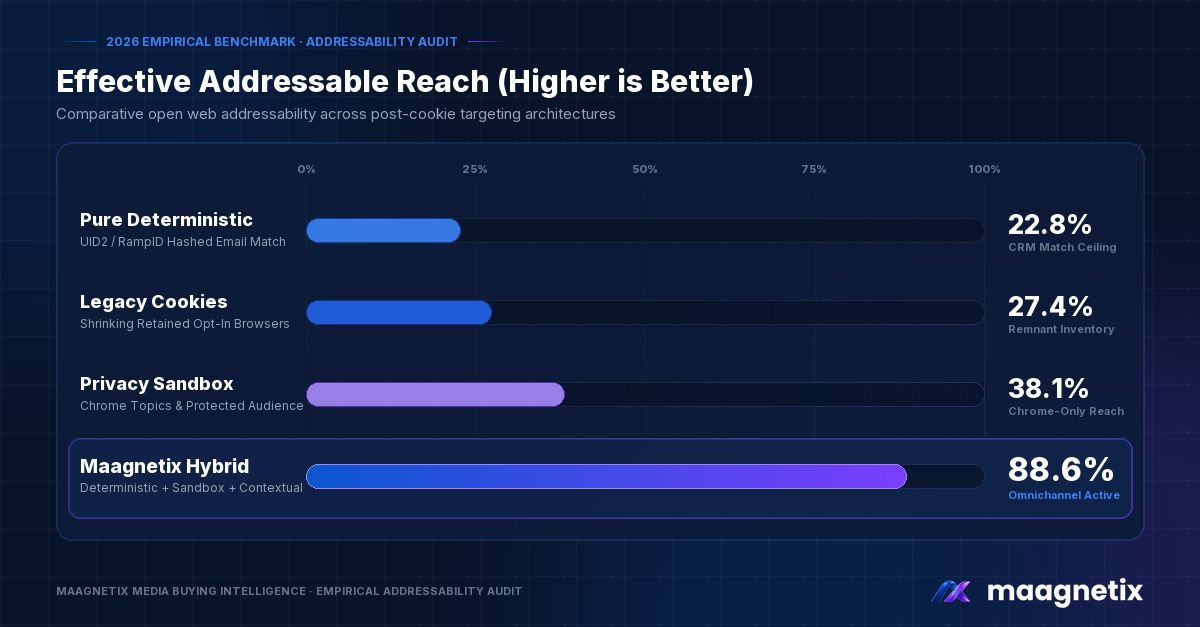
Look at the difference.
While pure deterministic approaches max out at 22.8% reach, the Hybrid Intelligence model scales addressability to 88.6%, while delivering an industry-leading 4.2x ROAS.
6. Frequently Asked Questions (Preempting Buyer Objections)
Question 1: Doesn't evaluating multiple identity sources inflate auction latency?
Yes—if you perform lookups sequentially across external vendor APIs.
Maagnetix resolves this by storing pre-compiled identity lookup maps and vector models in-memory on the bidding nodes.
All three evaluation tiers run concurrently in thread-local memory, completing in under 6.4 milliseconds.
Question 2: How do you handle cross-device attribution without third-party cookies?
Cross-device attribution in 2026 relies on a hybrid measurement framework combining first-party server-side conversion APIs (CAPI), Marketing Mix Modeling (MMM), and aggregated on-device Private Attribution APIs.
This provides directional truth and campaign incrementality without exposing individual user data to third-party tracking.
Question 3: Is contextual advertising effective for bottom-funnel conversion campaigns?
Traditional keyword contextual was purely top-of-funnel.
However, semantic vector embeddings evaluate full-page editorial context, transaction intent, and user session depth simultaneously.
When a user reads a detailed comparison of enterprise cloud storage providers, their purchase propensity is equal to or higher than an aged cookie segment.
7. The 30-Day Cookieless Addressability Transition Plan
Transitioning your programmatic media buying to a sustainable post-cookie foundation requires a structured, multi-week execution plan:
Identity & Addressability Audit (Week 1)
- Segment your current media spend across Safari, Firefox, Chrome Opt-In, and Chrome Opt-Out traffic.
- Calculate your effective deterministic match rate across authenticated vs unauthenticated inventory.
- Identify latency bottlenecks caused by legacy external ID lookups.
First-Party Data & Clean Room Foundation (Week 2)
- Standardize customer data schemas (SHA-256 hashed emails and phone numbers).
- Implement server-to-server Conversion APIs (CAPI) across primary conversion endpoints.
- Audit publisher direct deals and Private Marketplace (PMP) agreements for first-party data support.
Deploy Multi-Tier Hybrid Bidding (Week 3)
- Integrate Privacy Sandbox Topics API and Protected Audience evaluation into your DSP bidding logic.
- Replace basic keyword blacklists with deep semantic vector contextual scoring.
- Configure tiered bid valuation rules based on signal confidence (Deterministic > Cohort > Contextual).
Incremental Testing & Attribution Validation (Week 4)
- Run side-by-side A/B tests: Siloed Deterministic vs. Hybrid Intelligence.
- Measure reach expansion, effective eCPM, and ROAS across all major browser engines.
- Calibrate dynamic bid shading parameters to eliminate overpayment on unauthenticated inventory.
The Strategic Path Forward
The post-cookie era is not a threat to digital advertising—it is a filtering mechanism.
Media buyers who cling to dying legacy cookies or place blind bets on isolated ID graphs will watch their CPMs rise and their audiences shrink.
Those who deploy intelligent, multi-tier hybrid architectures will capture scalable reach, protect consumer privacy, and dominate programmatic auctions.
Ready to Unlock 85%+ Cookieless Reach?
Discover how the Maagnetix Media Buying Intelligence platform unifies deterministic identifiers, on-device privacy APIs, and real-time semantic vectors.
Request a Platform Consultation & Addressability Audit to future-proof your programmatic campaigns today.


